Is a 60Hz Monitor Good Enough for Gaming in the UK?
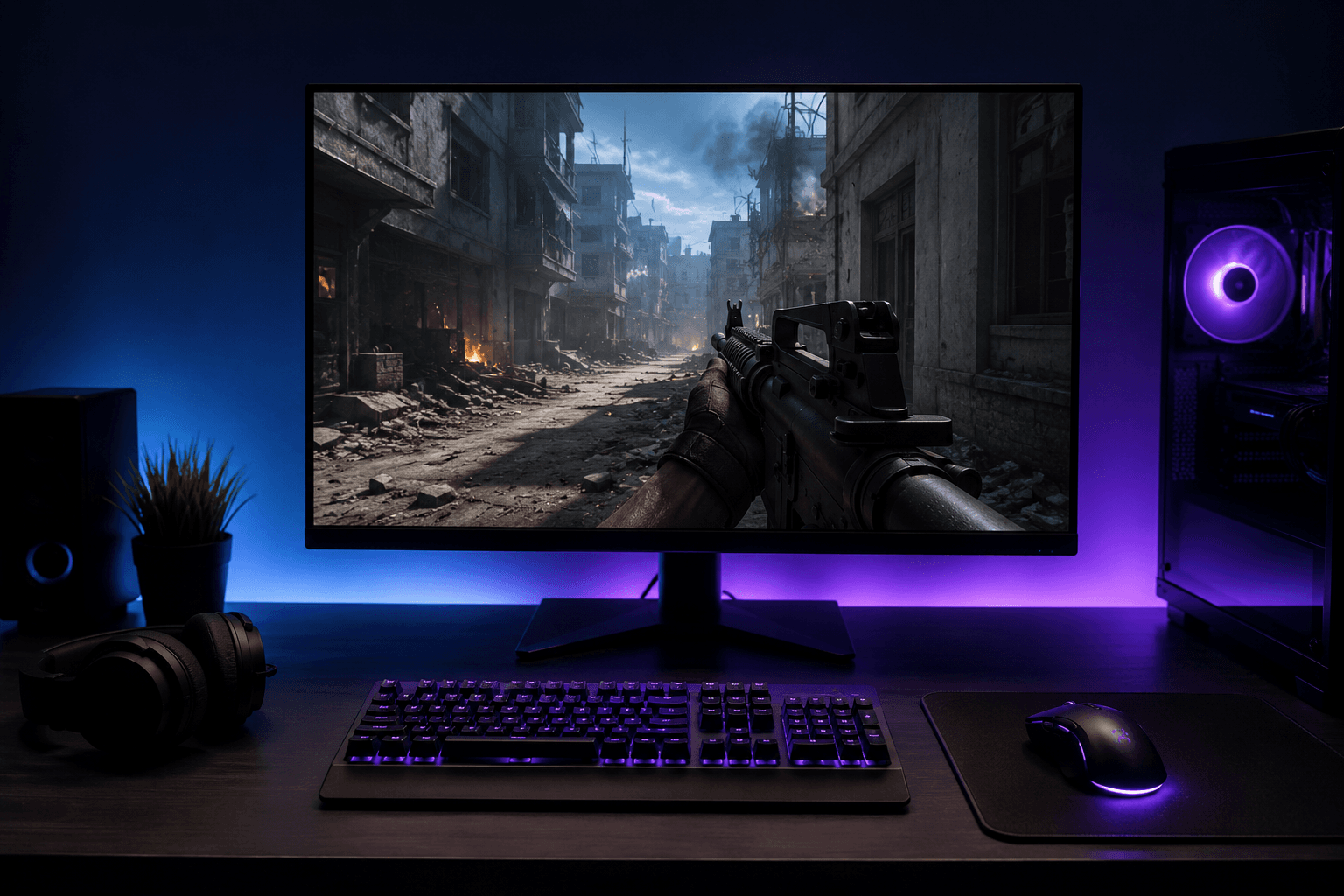
The honest answer is that it depends on what you play. For slow-paced strategy games, narrative RPGs, and turn-based titles, a 60Hz monitor is genuinely adequate and upgrading will not change your experience in any meaningful way. For anything fast-paced, including first-person shooters, battle royales, fighting games, or racing titles, 60Hz is a real limitation that affects both how the game looks and how it performs under your inputs.
For casual gaming on a tight budget, 60Hz gets the job done. For competitive gaming of any kind, 60Hz puts you at a disadvantage that no amount of skill, hardware quality, or peripheral investment can compensate for. The monitor is the final output of everything your PC produces, and a 60Hz screen limits that output to 60 frames per second regardless of what your GPU is rendering.
The good news is that 144Hz monitors have become affordable enough that the budget argument for staying on 60Hz has largely collapsed. You can get a solid 1080p 144Hz IPS monitor for well under £150, which changes the calculation significantly compared to even a few years ago.
What 60Hz Actually Means in Practice
At 60Hz your monitor refreshes the image on screen 60 times every second. Each frame is displayed for approximately 16.67 milliseconds before being replaced. In slow-paced games where nothing is moving quickly and reaction time is not critical, this is perfectly acceptable. The image looks fine, the game responds to inputs adequately, and nothing about the experience feels broken.
In fast-paced games the picture changes. When you turn quickly, enemies move across the screen, or projectiles travel toward you, the image held on screen for 16.67 milliseconds creates visible motion blur and smearing. Objects that have moved between frames appear to streak or ghost across the display. Fast-moving targets are harder to track and aim at precisely because the image showing their position is already out of date relative to where they actually are in the game.
This is not about whether you can see individual frames. The argument that humans cannot see above 60 frames per second is incorrect and has been comprehensively addressed. What you perceive at higher refresh rates is not individual frames but smoother motion, reduced blur, and a more immediate connection between your inputs and what appears on screen. These are things almost everyone notices immediately when moving from 60Hz to higher refresh rates, regardless of prior experience.
The Input Latency Problem at 60Hz
Beyond how motion looks, 60Hz creates a display latency issue that matters for competitive gaming. When your PC renders a frame and sends it to your monitor, the monitor does not display it instantly. It waits for the next refresh cycle. At 60Hz that cycle happens every 16.67 milliseconds. At 144Hz it happens every 6.94 milliseconds.
That difference means that at 60Hz your monitor is introducing up to 16.67 milliseconds of additional delay between when the game state updates and when you see it on screen. In a reflex-dependent game, that delay is significant. It means that what you are reacting to is already older information than it would be on a higher refresh rate display, and your inputs in response to it are landing later relative to the game state than they would on a faster display.
For competitive gaming where frame rate understanding matters, the 144Hz vs 240Hz decision is genuinely nuanced. Getting off 60Hz in the first place, however, is not nuanced at all. It is a straightforward upgrade that removes a clear and measurable disadvantage.
Which Games Are Fine on 60Hz
Being fair about this matters. Not every game suffers on a 60Hz monitor, and if your library consists primarily of the following types of titles, upgrading is not urgent:
Turn-based strategy and tactics games
✓ Games like Civilization, XCOM, and Total War involve no fast-paced action and no reflex-based gameplay
✓ 60Hz introduces no disadvantage and the visual difference from higher refresh rates is negligible
Story-driven RPGs and adventure games
✓ Games like Baldur's Gate 3, Cyberpunk 2077 played casually, or The Witcher series at a relaxed pace
✓ Visual fidelity matters more than refresh rate here, and 60Hz is perfectly adequate
✓ Note that if you play these titles at 60fps because your GPU cannot push higher frame rates at high settings, a better GPU matters more than a better monitor
Real-time strategy games
✓ RTS titles involve camera movement and unit selection rather than precise reflex-based aiming
✓ 60Hz works here, though higher refresh rates make camera panning feel noticeably smoother
Simulation games
✓ Flight sims, farming games, city builders, and similar titles have no competitive element and no fast-paced action that suffers at 60Hz
Which Games Suffer on 60Hz
These are the game types where 60Hz actively limits your experience, either in how the game feels or how you perform against other players:
First-person shooters
Fast target tracking, reaction-based aiming, and high frame rate output from capable hardware are all undermined by a 60Hz display. Counter-Strike 2, Valorant, Apex Legends, Call of Duty, Overwatch 2, and Rainbow Six Siege all benefit dramatically from higher refresh rates. Players on 60Hz in these games are at a measurable disadvantage against players on 144Hz, particularly in tracking moving targets and reacting to fast incoming action.
Battle royale games
Similar reasoning applies. High-speed movement, tracking targets at distance, and reacting to fast-approaching enemies all become easier with a higher refresh rate display. The competitive nature of these games means the disadvantage is felt directly in outcomes rather than just in visual comfort.
Fighting games
Frame-level precision matters in fighting games. At 60Hz you are seeing exactly the frames the game is producing if it runs at 60fps, but any movement or animation that exceeds that rate is being missed. Many modern fighting games run and benefit from higher frame rates, and the additional smoothness at 120Hz or higher makes timing windows more readable.
Racing games
High-speed movement is where 60Hz motion blur is most visible and most disruptive. Racing games at 144Hz feel dramatically more immersive and controllable than at 60Hz because the scene is updating so much more frequently during fast movement.
Does Your PC Matter Before Your Monitor?
Yes, and this is where a lot of buyers make an avoidable mistake. Buying a 144Hz monitor does not give you 144Hz gaming if your PC cannot produce 144 frames per second. The monitor displays whatever your PC sends it, up to its maximum refresh rate. If your GPU is pushing 70FPS in your main game, a 144Hz monitor will display 70FPS.
This means the decision about when to upgrade your monitor depends partly on what your system can actually output. If you are on a capable mid-range system that produces 120 to 200FPS in competitive titles at 1080p, a 144Hz or 240Hz monitor will immediately deliver its full benefit. If you are on older or lower-end hardware that struggles to reach 60FPS in the titles you play, a monitor upgrade is not the priority.
For anyone assessing whether a complete system upgrade or a fresh build makes more sense before investing in peripherals, looking at what a mid-range build delivers in real gaming scenarios is worthwhile. If you are considering a prebuilt route, checking out the best prebuilt gaming PCs UK gives a clear sense of what current builds deliver in terms of frame output at different price points.
The Budget Argument for 60Hz
A few years ago, the budget argument for staying on 60Hz made sense. A good 144Hz monitor cost £200 or more, and spending that on a monitor rather than GPU or CPU was a reasonable trade-off question.
Quality 144Hz IPS monitors at 1080p from brands like AOC, Acer, Philips, and BenQ are available for £90 to £130 in the UK. The price premium over a comparable 60Hz panel is small enough that buying a new 60Hz monitor at any price point is difficult to justify for gaming use. Even on a very tight budget, the difference in cost between a 60Hz option and a 144Hz option is unlikely to be more than £20 to £40.
If you already own a 60Hz monitor and are deciding whether to replace it, the question is whether your budget is better spent there or on a GPU upgrade. For someone on genuinely old or weak hardware, GPU first makes sense. For someone with a capable system already pushing high frame rates in their main games, a monitor upgrade delivers more noticeable improvement per pound than most other upgrades available at a similar cost.
Resolution vs Refresh Rate: Which Matters More for Gaming?
This is a question that comes up regularly, particularly from buyers choosing between a 1080p 144Hz monitor and a 1440p 60Hz monitor at a similar price.
For competitive gaming, refresh rate wins. A 1080p 144Hz display makes games feel dramatically more responsive than a 1440p 60Hz display, and the frame rate cost of running at 1440p further reduces the advantage of the higher resolution. If your goal is competitive performance in fast-paced titles, 1080p 144Hz is the correct starting point.
For a mixed use case where you play both competitive titles and visually rich single-player games, the answer becomes more personal. A 1440p 144Hz monitor covers both well if your GPU can sustain the frame rates, but costs more. Budget-constrained buyers who play both types of games often do better with a 1080p 144Hz monitor now and a 1440p upgrade later when GPU capability and budget both allow it.
On the GPU side, knowing what card you need to drive your target resolution and refresh rate is important before buying. The mid-range GPU market has moved quickly recently, and the gap between options at different price points has shifted. Our breakdown of RX 9060 XT vs RTX 5060 Ti looks at where the value sits in the current mid-range market for exactly these scenarios.
What About Console Gamers Moving to PC?
Many people buying their first gaming PC are coming from consoles where 60fps on a TV was the standard experience. If you are in this position, moving to PC at 60Hz on a comparable display does not feel like an upgrade in terms of smoothness, even if the visual fidelity is higher.
One of the things that makes PC gaming feel distinctly better than console gaming is the higher frame rate potential, and a 60Hz monitor prevents you from experiencing that advantage entirely. If the excitement of PC gaming is about better performance rather than just better graphics, a 144Hz monitor should be part of the initial setup rather than an upgrade considered later.
The combination of a capable mid-range PC with a 144Hz monitor running at 120 to 165FPS in competitive titles is an experience that no console setup currently matches, and it is achievable at a price point that is reasonable for a first gaming PC build.
What to Look for When Buying a 144Hz Monitor
If you have decided that 60Hz is not enough and you are looking at what to buy next, a few specifications matter beyond the refresh rate itself:
Response time
✓ Look for 1ms to 4ms GTG (grey to grey) response time
✓ Anything above 5ms can produce visible ghosting in fast motion on some panels
✓ IPS panels now regularly achieve 1ms GTG at competitive prices
Adaptive sync
✓ AMD FreeSync and NVIDIA G-Sync compatible monitors reduce screen tearing when frame rate drops below the monitor's refresh rate
✓ FreeSync is available on most monitors at no premium and works with both AMD and NVIDIA cards in its basic form
✓ G-Sync hardware modules add cost and are not necessary for most buyers
Panel type
✓ IPS for best all-round colour and response time combination
✓ TN for the lowest price entry to 144Hz if budget is the primary concern
✓ VA for better contrast if you also use the monitor for media but avoid it for competitive gaming
Ergonomics
✓ Height adjustment and tilt are worth having for long sessions
✓ Cheap monitor stands that only tilt are frustrating if you spend significant time at a desk
✓ VESA mounting compatibility lets you add an arm later if needed
Keeping the overall system running cool matters for sustained frame rate output too. A PC that throttles under load drops frame rates and undermines the monitor investment. If you are unsure whether your case cooling is sufficient to maintain performance, our look at PC case airflow and temps covers what actually affects temperatures and what you can do about it.
Frequently Asked Questions
Is 60Hz good enough for gaming?
For slow-paced strategy, RPG, and simulation games, yes. For any fast-paced or competitive gaming including FPS titles, battle royales, fighting games, and racing games, 60Hz is a measurable limitation that affects both visual quality and competitive performance.
Can you tell the difference between 60Hz and 144Hz?
Almost everyone can, immediately. The difference in motion smoothness, target clarity, and input responsiveness is one of the most noticeable single upgrades in gaming. The common claim that humans cannot see above 60fps is incorrect and has been consistently contradicted by both research and the experience of virtually everyone who has made the transition.
Is a 60Hz monitor worth buying for gaming?
No. 144Hz monitors are available for under £130 in the UK and represent a dramatically better experience for gaming. There is no meaningful budget justification for buying a new 60Hz monitor when the price gap to 144Hz is this small.
What frame rate do you need to benefit from 144Hz?
You start getting benefit from 144Hz at any frame rate above 60FPS. At 100FPS you are seeing noticeably smoother motion than 60Hz. The full benefit requires consistent output at or above 144FPS in your main titles.
Does a 60Hz monitor limit FPS?
Yes. A 60Hz monitor cannot display more than 60 frames per second regardless of what your GPU is producing. Any frames above 60FPS are wasted unless you are using the excess to reduce input latency through NVIDIA Reflex, AMD Anti-Lag, or similar technologies.
Is 1080p 144Hz better than 1440p 60Hz for competitive gaming?
For competitive gaming, 1080p 144Hz is the better choice. Refresh rate has a more direct impact on competitive performance than resolution, and the reduced GPU load at 1080p makes sustaining high frame rates easier.
How much should I spend on a 144Hz gaming monitor in the UK?
£90 to £150 covers quality 1080p 144Hz IPS options from reputable brands. Spending above £150 gets you better build quality, ergonomic stands, or higher resolution at the same refresh rate. Below £90 the options become limited but functional 144Hz TN panels do exist.
Final Thought
A 60Hz monitor is not broken and it will run your games. What it will not do is let you experience what a capable gaming PC can actually produce, keep up with what competitive gaming demands, or give you the kind of smooth and responsive feel that makes PC gaming worth the investment over console. The cost of upgrading to 144Hz has dropped to the point where there is very little reason to stay on 60Hz if you are building or buying a gaming setup from scratch. If you already own a 60Hz monitor and your PC is pushing well above 60FPS in your main titles, a 144Hz upgrade is likely the highest-impact change you can make to your gaming experience at a reasonable cost.