RX 9060 XT vs RTX 5060 Ti — Which Is Better Value?
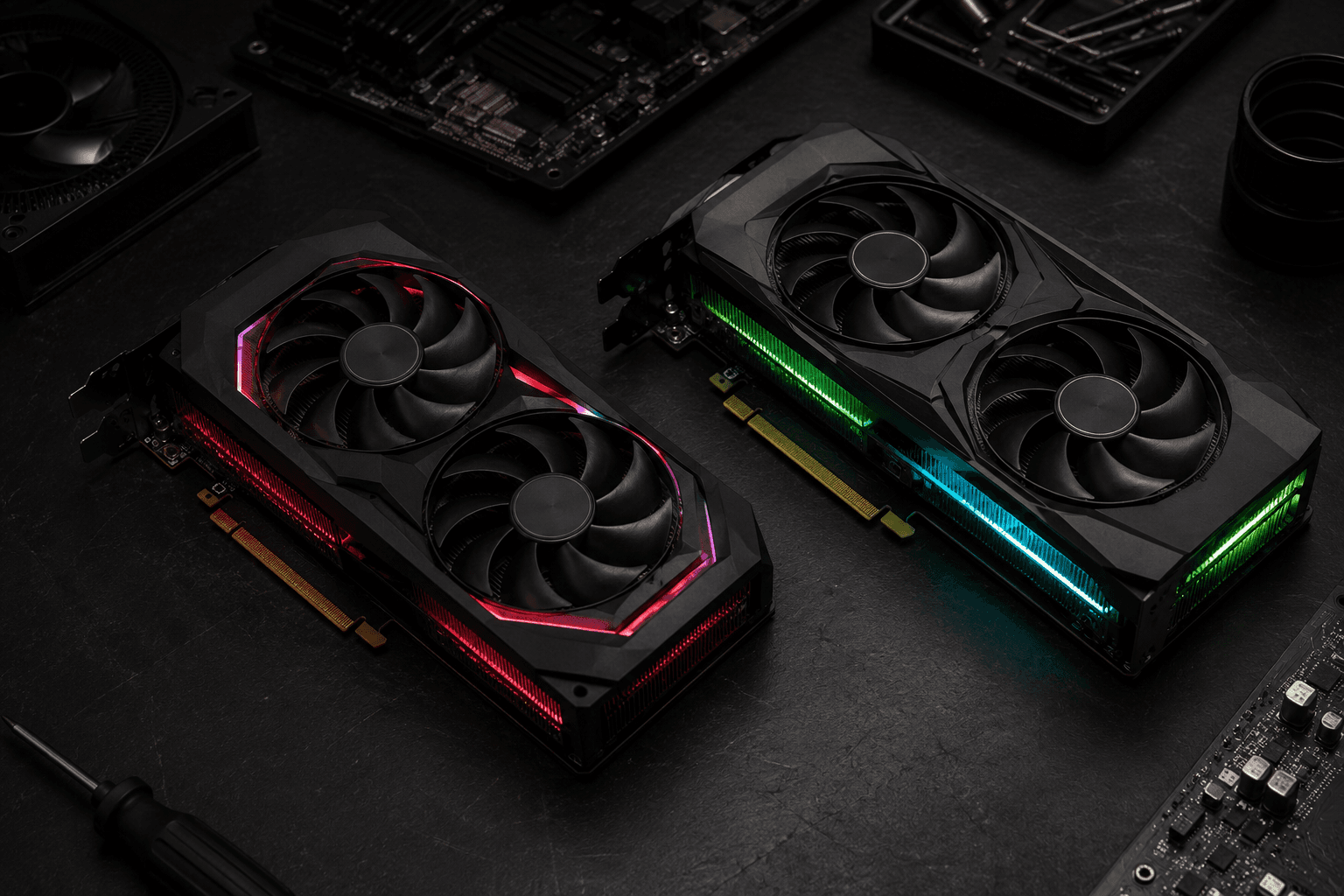
The short answer: if raw frame rates in standard rasterised games are your priority and you want to spend less, the RX 9060 XT is the stronger value pick. If you play heavily ray-traced titles, stream, or want DLSS 4, the RTX 5060 Ti justifies its higher price — but only just.
Both GPUs target the same market — 1080p and 1440p gaming — and both arrive with 16GB of VRAM on the recommended versions. The differences lie in the software ecosystem, ray tracing performance, and the price gap between them in the UK.
What You're Actually Comparing
The RX 9060 XT is built on AMD's RDNA 4 architecture and launched in June 2025. It comes in 8GB and 16GB configurations, though the 8GB variant has started showing VRAM limitations in some newer titles — buy the 16GB model or don't bother. It draws around 150 watts under load, which makes it genuinely power-efficient for what it delivers.
The RTX 5060 Ti runs on NVIDIA's Blackwell architecture and uses GDDR7 memory. That faster memory gives it a meaningful bandwidth advantage, which shows up particularly in high-resolution testing. It draws around 180 watts — not excessive, but 30 watts more than the AMD alternative. Both cards are widely available from UK retailers including Scan, Overclockers UK, and Aria, though stock and pricing fluctuate. The RTX 5060 Ti launched with MSRP pricing starting around £399, while the RX 9060 XT 16GB came in at a lower price point at launch.
If you're weighing up how much PSU wattage you'll need for a system based on either of these cards, a quality 650W unit handles both comfortably with room to spare.
Rasterised Gaming Performance
In standard rasterised games — which is still the majority of what most people actually play — the two cards are close. Benchmarks from independent testing across titles like Dragon's Dogma 2, Cyberpunk 2077 (without RT), and similar games show the RTX 5060 Ti holding a lead of roughly 7–11% at 1080p and 1440p.
That's a real difference, but it's not dramatic. At 1440p on high settings, the RX 9060 XT is comfortably playable in essentially every current title. The gap only becomes meaningful in the most demanding games at the upper end of quality settings.
For competitive gaming at 1080p — where you're targeting 144fps or higher in less GPU-intensive titles — the performance gap shrinks further, and both cards produce nearly identical results.
Ray Tracing and DLSS vs FSR
This is where the RTX 5060 Ti creates clear distance. Ray tracing performance on the 9060 XT has improved significantly compared to previous Radeon generations, and RDNA 4 closes the gap noticeably — but NVIDIA's dedicated RT hardware still leads in RT-heavy scenarios. In titles like Cyberpunk 2077 with Overdrive or path tracing enabled, the 5060 Ti is the stronger performer.
DLSS 4 is genuinely impressive. Multi Frame Generation, improved upscaling quality, and broader game compatibility make NVIDIA's software ecosystem a real consideration if you're planning a long-term build. FSR 4 from AMD has also improved substantially and works across a wider range of hardware — but head-to-head, DLSS still has the edge in image quality and smoothness.
If you're someone who genuinely plays heavily ray-traced games and values upscaling quality, the RTX 5060 Ti earns its premium. If you're playing competitive shooters, older titles, or anything that doesn't lean on RT, you're paying for features you won't use.
The VRAM Situation
Both cards at 16GB give you plenty of headroom for current and near-future gaming at 1080p and 1440p. This matters more than it might seem — we've already seen a number of 2024 and 2025 releases pushing beyond 8GB in some scenarios, and that trend isn't reversing.
The 8GB versions of both cards exist and are cheaper. Unless budget is genuinely tight and you plan to upgrade again in two years, they're not worth it. Get the 16GB version of whichever you choose, or wait until you can.
This links directly to a broader question about how much VRAM you actually need for gaming — if you're targeting 1440p specifically, 16GB makes sense as the minimum for anything you want to keep for three or more years.
UK Pricing and Value
At launch, the price gap between the RTX 5060 Ti and RX 9060 XT 16GB in the UK was meaningful enough that AMD looked like the obvious value play. The 5060 Ti launched at around £399 at MSRP; the 9060 XT came in lower.
That said, GPU pricing shifts constantly, and the gap at any given moment depends on which retailer you're using and what's in stock. Before buying either, check current pricing at Scan, Overclockers UK, and Amazon UK — the spread can be £30–50 depending on the week.
If the 5060 Ti is only £20–30 more, the decision becomes harder and DLSS 4 starts to look more compelling. If the gap is £50 or more, the 9060 XT represents genuinely strong value for the majority of gaming use cases.
Who Should Buy Which
The RX 9060 XT 16GB makes sense if:
✓ You primarily play rasterised games without heavy RT
✓ Power consumption matters — whether for efficiency or PSU headroom
✓ The price gap at the time of purchase is £40 or more
✓ You don't use NVIDIA-specific features like DLSS or CUDA-accelerated software
✓ You want the most frames per pound in standard workloads
The RTX 5060 Ti 16GB makes sense if:
✓ You play ray-traced titles regularly
✓ You stream and want NVENC encoding quality
✓ You use AI-accelerated creative software like DaVinci Resolve or Stable Diffusion
✓ The price gap is small and DLSS 4 is a genuine priority
✓ You want the broader NVIDIA software ecosystem for long-term flexibility
A Note on the 8GB Versions
Both cards also come in 8GB configurations, and both are significantly cheaper as a result. The problem is they're already showing limitations in some 2025 releases, and that's only going to become more pronounced over the next two to three years.
If you can only afford the 8GB version of either, you're better off either saving a bit longer for the 16GB model, or considering last-generation cards that have dropped significantly in price. An RX 7800 XT or RTX 4060 Ti 16GB on the used market can offer reasonable value depending on the price. Buying a current-generation 8GB card at nearly the same price as the 16GB variant makes no sense.
What We'd Choose
Honestly, at typical UK pricing, the RX 9060 XT 16GB is the pick for most people. The performance gap in everyday rasterised gaming is small, the power consumption advantage is real, and the price difference means you can spend what you save on a better CPU or more storage without taking a hit to GPU performance that most people would notice in practice.
The RTX 5060 Ti is the right call if you play path-traced or heavily ray-traced games, stream regularly, or the pricing has closed to a small gap. DLSS 4 is genuinely useful software. But for a straightforward gaming rig that handles 1080p and 1440p well, AMD wins on value here.
If you're putting together a full custom build around either card and want help with the rest of the spec, you can configure your own system and see how the GPU fits into a balanced setup at your budget.
FAQs
Is the RX 9060 XT better than the RTX 5060 Ti?
In rasterised gaming performance per pound, the RX 9060 XT is the stronger value choice for most buyers. The RTX 5060 Ti leads in ray tracing and has a superior upscaling ecosystem through DLSS 4, but costs more.
Which VRAM size should I buy — 8GB or 16GB?
The 16GB version of either card. The 8GB variants are already showing limitations in some 2025 titles and will age poorly. If the 16GB is out of budget, consider waiting or looking at last-gen alternatives.
Does the RX 9060 XT support ray tracing?
Yes. RDNA 4 has significantly improved AMD's ray tracing performance over previous generations. It's not on par with the RTX 5060 Ti in RT-heavy scenarios, but the gap is smaller than it was on RX 6000 and 7000 series cards.
Is DLSS 4 worth paying extra for?
If you play games that support it and value image quality in upscaled modes, yes. Multi Frame Generation is a meaningful feature. If you mainly play competitive games at native resolution, you likely won't use it enough to justify the cost difference.
What PSU do I need for these GPUs?
A quality 650W Gold-rated PSU handles either comfortably with a mid-range CPU. A 750W unit gives you more headroom for higher-TDP processors or a more ambitious build.
Which is better for streaming — RX 9060 XT or RTX 5060 Ti?
The RTX 5060 Ti. NVENC on Blackwell architecture is excellent and widely supported by streaming software. AMD's encoder has improved but NVIDIA holds the advantage for streaming and recording quality.
Can either of these cards run 4K?
Both can run 4K in less demanding titles or with upscaling enabled, but neither is a 4K-native gaming GPU. They're designed for 1080p and 1440p. For 4K without relying heavily on upscaling, you'd want to step up to the RTX 5070 tier or above.