RTX 4070 vs RTX 4080: Which GPU Should You Buy?
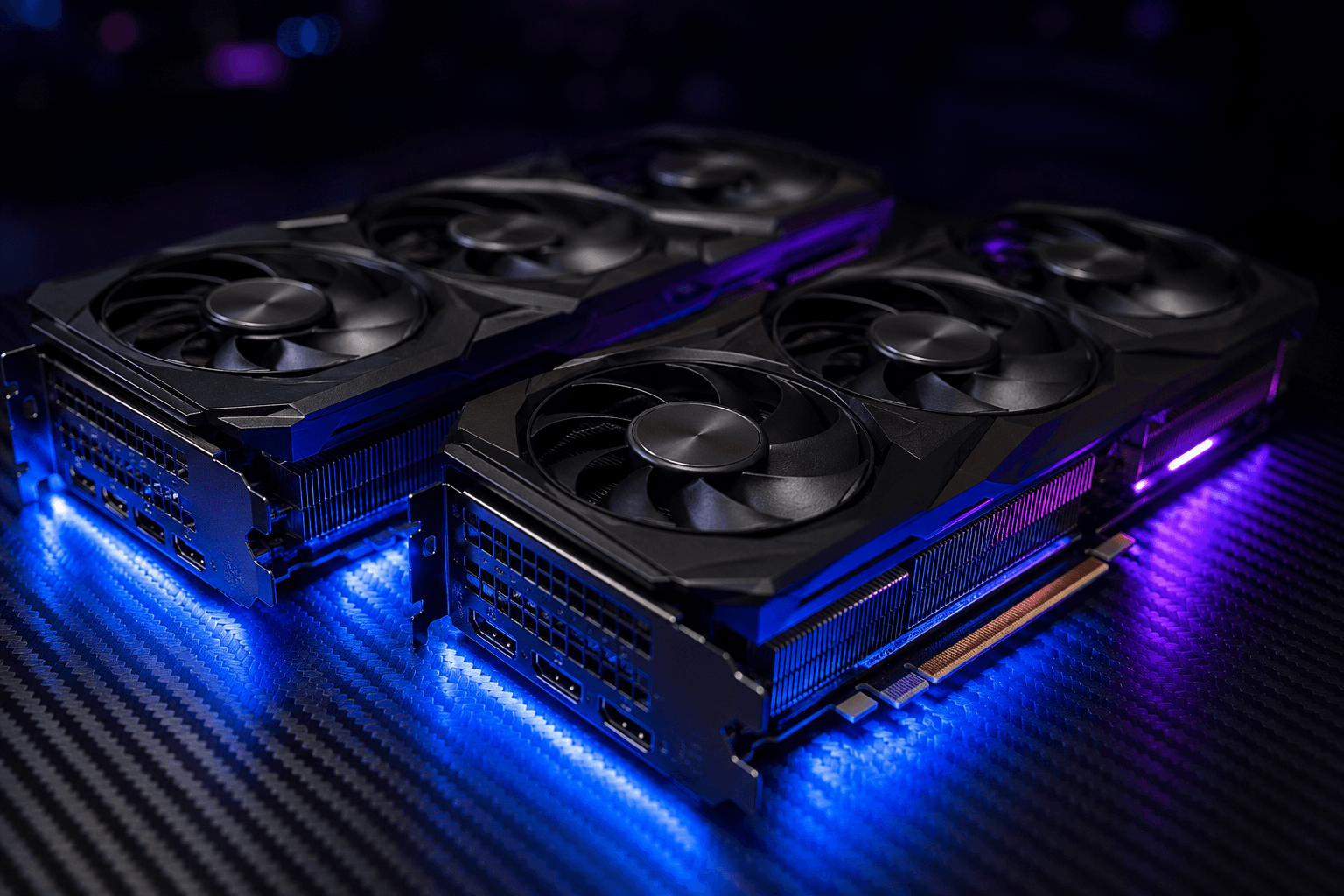
The RTX 4070 and RTX 4080 are two of the most searched graphics cards in the UK right now, and for good reason — they sit at completely different ends of the mainstream-to-enthusiast spectrum. The short answer is this: for most people gaming at 1440p, the RTX 4070 is the smarter buy. The RTX 4080 is a genuinely outstanding card, but its price point means you need to be building a very specific kind of system to justify it.
That said, there's a lot more to it than that. Let's break both cards down properly.
What You're Actually Getting with Each Card
The RTX 4070 is built on NVIDIA's Ada Lovelace architecture and targets 1440p gaming as its sweet spot. It has 12GB of GDDR6X VRAM, 5,888 CUDA cores, and a 192-bit memory bus. It runs cool and quiet, fits in most cases without drama, and draws around 200W under load. For most gaming builds in the UK today, it hits a genuinely comfortable balance between performance and cost.
The RTX 4080 is a different beast entirely. It carries 16GB of GDDR6X, 9,728 CUDA cores, and a 256-bit memory bus. Power consumption sits around 320W under full load, it's a physically large card, and it commands a price premium that's hard to ignore. At 4K it genuinely pulls away from the 4070, but at 1440p the gap is smaller than the price difference suggests.
Performance Comparison: Where the Difference Actually Shows
At 1080p, neither card breaks a sweat with modern titles. You're largely GPU-overkill at that resolution with either option, so if your monitor tops out at 1080p, the 4070 is the obvious choice and the 4080 is a waste of money.
At 1440p, the RTX 4070 handles demanding titles confidently — typically between 80 and 120+ fps depending on the game and settings. The RTX 4080 does better, but often by a margin of 20–30%, not double. When you factor in that the 4080 costs significantly more, you're paying a steep premium for a relatively modest real-world improvement at this resolution.
At 4K, the picture changes. The RTX 4080 handles 4K at high settings in demanding titles far more comfortably, and the 16GB VRAM buffer starts to matter with texture-heavy games and higher resolutions. If you've invested in a quality 4K display and want to run everything maxed out with ray tracing enabled, the 4080 earns its premium here. The 4070 can do 4K, but you'll find yourself dropping settings more often than you'd like.
Ray Tracing and DLSS: Does It Change the Decision?
Both cards support DLSS 3, including Frame Generation, which NVIDIA introduced with the 4000 series. Frame Generation can effectively double perceived frame rates in supported titles, and it works well on both cards. Ray tracing is also supported by both, but the performance cost is high — particularly at 4K. The RTX 4080 handles demanding ray tracing scenarios noticeably better, especially in titles like Cyberpunk 2077 with Overdrive mode enabled.
One common mistake I see is people deciding between these cards based on ray tracing benchmarks without ever actually using ray tracing in their gaming. If you play competitive titles, strategy games, or older releases, ray tracing performance is largely irrelevant to your buying decision. Focus on raw rasterisation performance for the resolution and titles you actually play.
VRAM: Does 12GB vs 16GB Matter?
At 1440p, 12GB is currently fine for the vast majority of games. There are a handful of titles — particularly heavily modded games or those with very high-resolution texture packs — where 12GB can feel tight, but this is the exception rather than the rule. The 16GB on the RTX 4080 gives more breathing room for future titles and creative workloads, but for gaming at 1440p today, it's not a deciding factor.
At 4K with maximum texture settings, 16GB becomes more relevant. Some demanding titles are already pushing close to 12GB at 4K ultra, so if that's your target, the additional VRAM on the 4080 has genuine value rather than being a marketing spec.
Power, Temperature, and System Compatibility
The RTX 4070 draws around 200W under load. It runs cool, fits into mid-tower cases comfortably, and doesn't demand a massive power supply — a quality 650W unit handles it without issue. If you're building in a compact case or working with a smaller PSU, this matters.
The RTX 4080 draws around 320W and requires a beefier setup to match. You'll want at least a 750W PSU, ideally an 850W unit for headroom, and the card itself is large — triple-slot designs are common, and some versions push past 320mm in length. Case compatibility needs checking before you buy. For context, if you're considering a custom PC build under £1000, the RTX 4080 is going to eat through your entire budget on the GPU alone, which is never a good outcome.
Price and Value in the UK
This is where honest advice matters most. In the UK, the RTX 4070 typically sits around £450–£500 at retail. The RTX 4080 regularly comes in between £900–£1,100 depending on the model and retailer. That's roughly double the cost for a card that — at 1440p — delivers around 20–30% better performance in most titles.
From a pure value standpoint, the RTX 4070 wins this comparison for the majority of buyers. The 4080 isn't bad value in isolation — it's an excellent card — but it's priced for a tier of user that genuinely needs what it offers. Many people spend too much on the GPU while neglecting the rest of the system, and buying an RTX 4080 for a build with a mid-range CPU and a 1440p monitor is exactly that kind of mistake.
Who Should Buy the RTX 4070?
→ Gaming primarily at 1440p → Budget of £400–£550 for the GPU → Mid-tower or compact build → Pairing with a Ryzen 5 or Core i5-level CPU → 650W PSU already in the system → No professional workload requirements
The RTX 4070 is the right card for most people reading this. It handles 1440p gaming with confidence, supports DLSS 3 and Frame Generation, runs efficiently, and leaves meaningful budget for the rest of the build. If you want to understand how GPU choice fits into the broader build picture, the complete guide to building your first gaming PC covers how to balance spending across every component.
Who Should Buy the RTX 4080?
→ Gaming at 4K on a quality display
→ Running GPU-intensive creative workloads (3D rendering, video production)
→ Pairing with a high-end CPU such as a Ryzen 9 or Core i9
→ Budget that can absorb a £900–£1,100 GPU without compromising elsewhere
→ Looking for maximum performance with longevity in mind
The RTX 4080 makes sense for a narrower group of buyers. If you're running a 4K display, doing serious creative work alongside gaming, or building a no-compromise system where budget genuinely isn't the constraint, it's worth the investment. Just be honest with yourself about whether your use case actually justifies it.
What About the RTX 4070 Ti and 4070 Super?
Worth mentioning because they complicate the comparison. NVIDIA released the RTX 4070 Super and RTX 4070 Ti Super as part of the Ada Lovelace refresh. The 4070 Super in particular offers noticeably better performance than the standard 4070 at a relatively modest price increase, and it's worth considering as a middle-ground option. It doesn't match the 4080, but it closes the gap more than the original 4070 manages. If your budget stretches to £550–£650, the 4070 Super is worth looking at seriously before jumping to the 4080.
Common Mistakes When Choosing Between These Cards
One mistake I see regularly is buying the RTX 4080 for a 1440p 144Hz monitor. The monitor will never show you the difference you paid for, and that money would have served the build far better elsewhere — in faster RAM, a better CPU, or NVMe storage. The GPU needs to be matched to your display, not the other way around.
Another common issue is pairing an RTX 4080 with a CPU that creates a significant bottleneck. If you want to understand how CPU and GPU balance affects performance, getting that pairing right matters as much as the GPU choice itself. A high-end GPU in an unbalanced system often performs no better than a mid-range card in a well-matched one.
FAQs
Is the RTX 4070 good enough for 4K gaming?
It can handle 4K in less demanding titles, but for modern AAA games at 4K ultra settings, it will struggle to maintain smooth frame rates. You'll need to drop settings to hit acceptable performance. The RTX 4080 is the more appropriate choice if 4K is your primary target.
How much faster is the RTX 4080 compared to the RTX 4070?
At 1440p, the RTX 4080 is typically 25–35% faster in demanding titles. At 4K, the gap widens further, particularly with ray tracing enabled. Whether that difference justifies roughly double the price depends entirely on your use case.
Is 12GB VRAM enough in 2026?
For 1440p gaming, yes — 12GB handles the vast majority of current titles comfortably. Some texture-heavy games at 4K can push against it, but at 1440p it's not a concern for most users right now.
Can I run an RTX 4080 on a 650W PSU?
Technically possible, but not recommended. The RTX 4080 draws around 320W at peak, and when combined with a modern CPU, a 650W unit leaves very little headroom. A quality 750W PSU is the minimum sensible choice; 850W gives proper breathing room.
Is the RTX 4070 Super worth it over the standard 4070?
In most cases, yes. The performance uplift is meaningful, and the price difference between the standard 4070 and Super models is typically modest enough to justify the upgrade. It sits in a sensible position between the 4070 and 4080 in both price and performance.
Will the RTX 4070 still be relevant in two or three years?
Almost certainly at 1440p. VRAM is a legitimate consideration longer term, but 12GB has held up well so far and DLSS helps extend the card's useful life even as games become more demanding.
Does the RTX 4080 support DLSS 3 and Frame Generation?
Yes. Both the RTX 4070 and RTX 4080 fully support DLSS 3 including Frame Generation, which requires an RTX 4000 series card. This is one of the clearest advantages either card has over last-generation options.
The Bottom Line
For most people in the UK building or upgrading a gaming PC right now, the RTX 4070 is the right call. It handles 1440p gaming well, runs efficiently, leaves room in the budget for a balanced build, and will stay relevant for years with DLSS backing it up. The RTX 4080 is genuinely excellent — there's nothing wrong with it technically — but it's a card that demands a specific use case to justify its cost. If you're gaming at 4K on a high-quality display or running serious creative workloads, it earns its place. For everyone else, the 4080 is an expensive answer to a question most builds aren't asking.
If you're ready to put a system together around either card, you can configure your build directly through our PC Builder or browse our range of gaming PCs to see what we currently have available.